
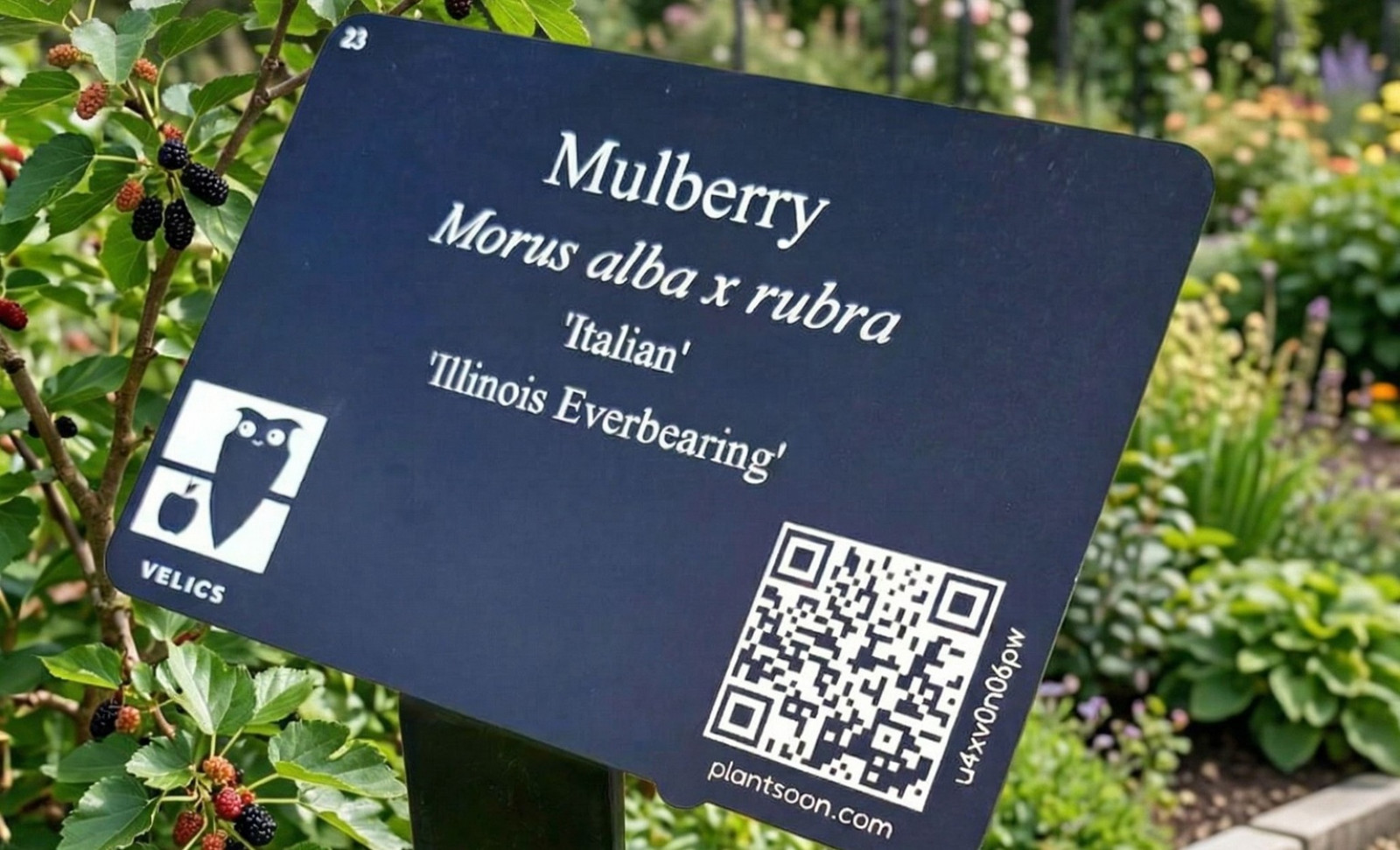
A static sign and an experience are two different things. A sign asks for a few seconds and hands over a few facts. An experience asks for the same few seconds but opens onto something a visitor can choose to enter — and, if it is good, want to repeat. The gap between the two is where most plant labels quietly fail, and it is also where the research points to a way out.
The few seconds you actually get
Start with an uncomfortable baseline. Plants are easy to walk past: the tendency to overlook the plants in our own surroundings is documented well enough to have a name — “plant blindness,” coined by the botanists and educators Wandersee and Schussler in 1999.¹ A label therefore begins at a disadvantage, competing for attention the visitor's eye is not naturally inclined to give. Before anyone can read a label at all, their attention first has to settle on the plant — the obstacle explored in our companion piece on plant blindness.
And the attention on offer is brief. A 2024 eye-tracking study of botanic-garden signage by Spooner, Heath and Dymond found that visitors fixate on an individual sign only fleetingly, that dense panels carrying longer texts were skimmed or skipped, and that simple, image-led designs — especially those placed centre-left of a display, where the eye lands first — held attention best.² A label that opens with a Latin name and a paragraph of taxonomy has, in effect, already lost the reader it was written for.
A sign asks for a few seconds and hands over a few facts. An experience asks the same few seconds and opens onto something the visitor can choose to enter.
Information was never the point
This is where a sixty-year-old idea earns its keep. In 1957, writing for the US National Park Service, Freeman Tilden argued that good interpretation is not the same as information. Interpretation, he wrote, is revelation based on information rather than information itself; its chief aim is provocation, not instruction; and it should relate what is shown to the personality and experience of the visitor.³
The implication for a plant label is direct. A label that recites a species' classification is information. A label that asks “Why does this tree shed its bark each summer?” is interpretation — it relates to the visitor, provokes a question, and offers a reason to look closer. The facts can follow for anyone who wants them, but facts are not what win a visitor's interest in the first place. The question is. A garden that grasps this stops measuring a label by how much it says and starts measuring it by how much it makes the visitor want to know.
Why the interactive layer matters
If the surface of a label must be short and provoking, the depth has to live somewhere else. This is the role of the digital layer behind a scan — and here the evidence carries a useful warning rather than a blank endorsement.
When Pérez-Sanagustín and colleagues tested QR codes in museum-like spaces, the result was not a simple win for the technology. Visitors often preferred direct delivery — a screen, or plain printed text — to a basic QR code that merely linked to more reading.⁴ What did raise engagement was interactivity: “two-way” QR experiences, which invited the visitor to do something rather than passively receive more text, outperformed the traditional one-way kind.⁴ The lesson is not “add a QR code and you are done.” It is that the experience behind the scan has to be worth the scan — responsive, layered, and built for participation, not used as a place to dump the paragraph you wisely removed from the sign. In practice that means the scan should open onto something a visitor can move through — turn a leaf, hear birdsong, compare a plant across two seasons — rather than a wall of text relocated from the sign to a screen.
From experience to return visit
So far the chain runs like this: a brief glance, won by interpretation rather than information, opening onto an interactive depth. The final link is the one that matters most to anyone running a garden — does any of this bring people back?
Here the visitor-studies literature is encouraging, with an honest caveat. In a structural study of botanic-garden visitors in Central Florida, Shapoval, Rivera and Croes found that the quality of the garden and of the visitors' experience predicted both their satisfaction and their stated intention to visit again, and that first-time and repeat visitors differed in what shaped those intentions.⁵ The engine of return intention, in their data, is the experience itself — not the sheer quantity of information a visitor was handed.
No single study proves that an interactive label, on its own, manufactures a returning guest; a decision to come back depends on far more than signage. (That synthesis is Plantsoon's, drawn from the strands above rather than from one experiment.) But the strands align. Experience quality drives the intention to return.⁵ Interpretation and interactivity improve the quality of the experience.³ ⁴ A label that turns a passing glance into a small, satisfying encounter is doing precisely the kind of work the research connects to coming back.
What this means for your green space
The practical shift is to stop treating a label as a container for facts and start treating it as the opening line of an experience. Make the surface short and arresting, so that it wins the few seconds you are actually given.² Make it interpretive rather than informational, so that it relates to the visitor and provokes a question instead of reciting an answer.³ Make the depth behind it interactive and generous, so that the scan rewards the curiosity the surface created.⁴
Most visitors will still glance and walk on, and that is no failure; a good glance is the start of a story, not a broken promise. Some will stop, scan, and leave with the sense that the garden showed them something rather than simply told them something — and that feeling, more than any single fact, is what the evidence ties to walking back through the gate.⁵
Sources
- 1. Wandersee JH, Schussler EE. Preventing plant blindness. The American Biology Teacher. 1999;61(2):82–86. Available from: https://online.ucpress.edu/abt/article/61/2/82/15933/Preventing-Plant-Blindness
- 2. Spooner SL, Heath N, Dymond T. Using eye-tracking to create impactful interpretation signage for botanic gardens and other visitor attractions. Journal of Zoological and Botanical Gardens. 2024;5(3):434–454. Available from: https://www.mdpi.com/2673-5636/5/3/29
- 3. Tilden F. Interpreting our heritage. Chapel Hill (NC): University of North Carolina Press; 1957. Available from: https://uncpress.org/9780807858677/interpreting-our-heritage/ [book]
- 4. Pérez-Sanagustín M, Parra D, Verdugo R, García-Galleguillos G, Nussbaum M. Using QR codes to increase user engagement in museum-like spaces. Computers in Human Behavior. 2016;60:73–85. Available from: https://www.sciencedirect.com/science/article/abs/pii/S0747563216300644
- 5. Shapoval V, Rivera M, Croes R. The quality of gardens tourism and the visitor experience: differentiating between first time and repeat visitors. Annals of Leisure Research. 2021;24(4):449–467. Available from: https://www.tandfonline.com/doi/abs/10.1080/11745398.2020.1744174