
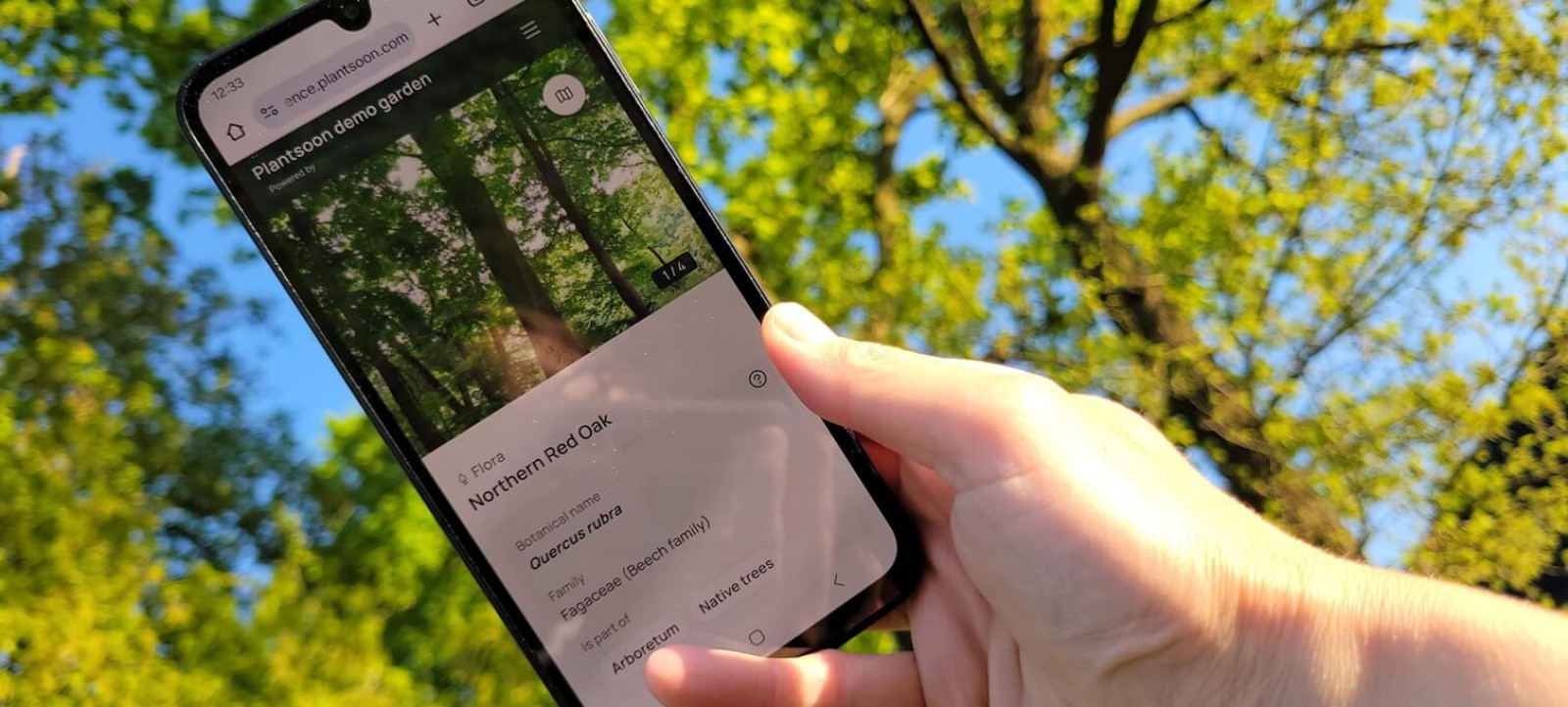
Here's an awkward question if you hang digital labels in a garden. People come to a green space, partly, to get away from their screens. And here we are, asking them to pull that screen back out and point it at a shrub. So isn't a QR code on a plant a small betrayal of everything the garden stands for?
It's a fair question, and it deserves a straight answer instead of a defence. The paradox is real, and the research explains exactly why. But it goes away the moment you see where the real problem sits. Not in the device, but in what you do with it.
The worry is legitimate
Take the objection seriously first, because there's science behind it. One reason nature does us good is that it rests a certain kind of attention. A kind that runs out. Stephen Kaplan called it directed attention: the effortful, focused kind you spend all day at work and on your screen. It gets tired. And nature tops it back up through what he called soft fascination: the way you can't help but watch moving water, light through the leaves, birds.¹ A phone screen is the exact opposite of soft fascination. It demands the very attention you came to the garden to rest.
And there's plain evidence that a phone flattens the moment. In a field experiment, Dwyer, Kushlev and Dunn had people share a meal. The ones who left their phone on the table enjoyed it less than the ones who put it away.² Splitting your attention costs you something. And if a phone can quietly drain the fun out of dinner with friends, it can do the same to a walk among the trees.
So the feeling that a garden and a screen don't go together isn't technophobia. It's roughly what you'd expect from the research.
The data cuts both ways
Stopping there would be easy, but the real story is more interesting. In a big study using smartphone sensor data, Minor and colleagues found that time in nature usually went together with less phone use. But it depended a lot on the place. In wilder, greener spots phone use dropped; in urban parks it actually went up.³ And a managed public garden looks far more like a park than like wilderness. So it's exactly the kind of place where the phone fights hardest for your attention.
That matters, because it takes away the easy excuse. As a garden, you can't assume all that green will switch the phones off by itself. If anything, the research points the other way: the phone is already out, or about to be. The only real question is what it's doing.
It's not the device, it's what you do with it
And that's where the paradox falls apart. Because "phone use" isn't one thing. A bottomless feed that pulls your attention everywhere is a completely different thing from one focused scan that points your attention at the plant in front of you. With the first, you stay stuck on your phone. With the second, you're back at the plant in a few seconds.
A feed is built never to stop. It fragments your attention on purpose, and that's exactly the phone use the restoration research rightly warns about.¹ ² A scan that opens one plant's story and then stops is a different animal entirely. In the ten seconds it lasts, it doesn't pull you away from the garden. It pushes you deeper into it: toward this tree, this bark, this story. Used that way, the phone doesn't fight the plant for your attention. It hands the plant the attention it wouldn't otherwise get.
A ten-second scan that makes someone look at a tree for two minutes longer isn't screen time stolen from nature. It's nature time bought with a screen.
What a good scan actually does
Whether a scan helps you along or keeps you glued to your phone comes down to design. And the research is surprisingly clear about it. When Pérez-Sanagustín and colleagues tested QR codes in museum-like spaces, a bare code that just threw more text onto your screen did almost nothing. What did help was a code that led to something genuinely interactive: something that asked you to do, compare or notice, instead of just read.⁴ So a badly made digital layer really does make things worse. You just move a wall of text from the sign onto the phone and call it progress.
And the bigger question is what the scan is even for. Passing on information was never the point. When Lumber, Richardson and Sheffield looked at what really strengthens your bond with nature, the things that worked were contact, emotion, meaning and beauty. Not names and facts.⁵ So a good scan adds a little layer of meaning and then gets out of the way: a story, a question, a reason to look again. Not a lesson that keeps your eyes down. And the end point is always real contact. Because plant awareness grows from doing, not from reading, and that's one more reason to keep the phone brief.⁶ It's about hands on the bark, not eyes on the glass.
Resolving the paradox
The paradox goes away the moment you stop seeing the phone as the experience and start seeing it as a key. The question was never whether to let screens into the garden; the research says they come in anyway.³ The question is what you do with them. A scan that lands on a wall of text, or worse, pushes you back into the feed, really is a small betrayal of the garden. But a scan that takes you to one good story and then sets you back down, richer, at the tree in front of you is the opposite. That's the garden using the one device you already trust to make you look harder at something alive.
Most people turn up with a phone in their pocket. That's nothing to complain about; that channel is already open. Use it to point attention at the living collection, briefly and well. And then let the plant do the rest. The betrayal was never the QR code. The betrayal is the QR code that forgets to send you back to the garden.
Sources
- 1. Kaplan S. The restorative benefits of nature: toward an integrative framework. Journal of Environmental Psychology. 1995;15(3):169–182. Available from: https://www.sciencedirect.com/science/article/pii/0272494495900012
- 2. Dwyer RJ, Kushlev K, Dunn EW. Smartphone use undermines enjoyment of face-to-face social interactions. Journal of Experimental Social Psychology. 2018;78:233–239. Available from: https://www.sciencedirect.com/science/article/abs/pii/S0022103117301737
- 3. Minor K, Glavind KL, Schwartz AJ, Danforth CM, Lehmann S, Bjerre-Nielsen A. Nature exposure is associated with reduced smartphone use. Environment and Behavior. 2023. Available from: https://journals.sagepub.com/doi/abs/10.1177/00139165231167165
- 4. Pérez-Sanagustín M, Parra D, Verdugo R, García-Galleguillos G, Nussbaum M. Using QR codes to increase user engagement in museum-like spaces. Computers in Human Behavior. 2016;60:73–85. Available from: https://www.sciencedirect.com/science/article/abs/pii/S0747563216300644
- 5. Lumber R, Richardson M, Sheffield D. Beyond knowing nature: contact, emotion, compassion, meaning, and beauty are pathways to nature connection. PLOS ONE. 2017;12(5):e0177186. Available from: https://journals.plos.org/plosone/article?id=10.1371/journal.pone.0177186
- 6. Jose SB, Wu C-H, Kamoun S. Overcoming plant blindness in science, education, and society. Plants, People, Planet. 2019;1(3):169–172. Available from: https://nph.onlinelibrary.wiley.com/doi/full/10.1002/ppp3.51