
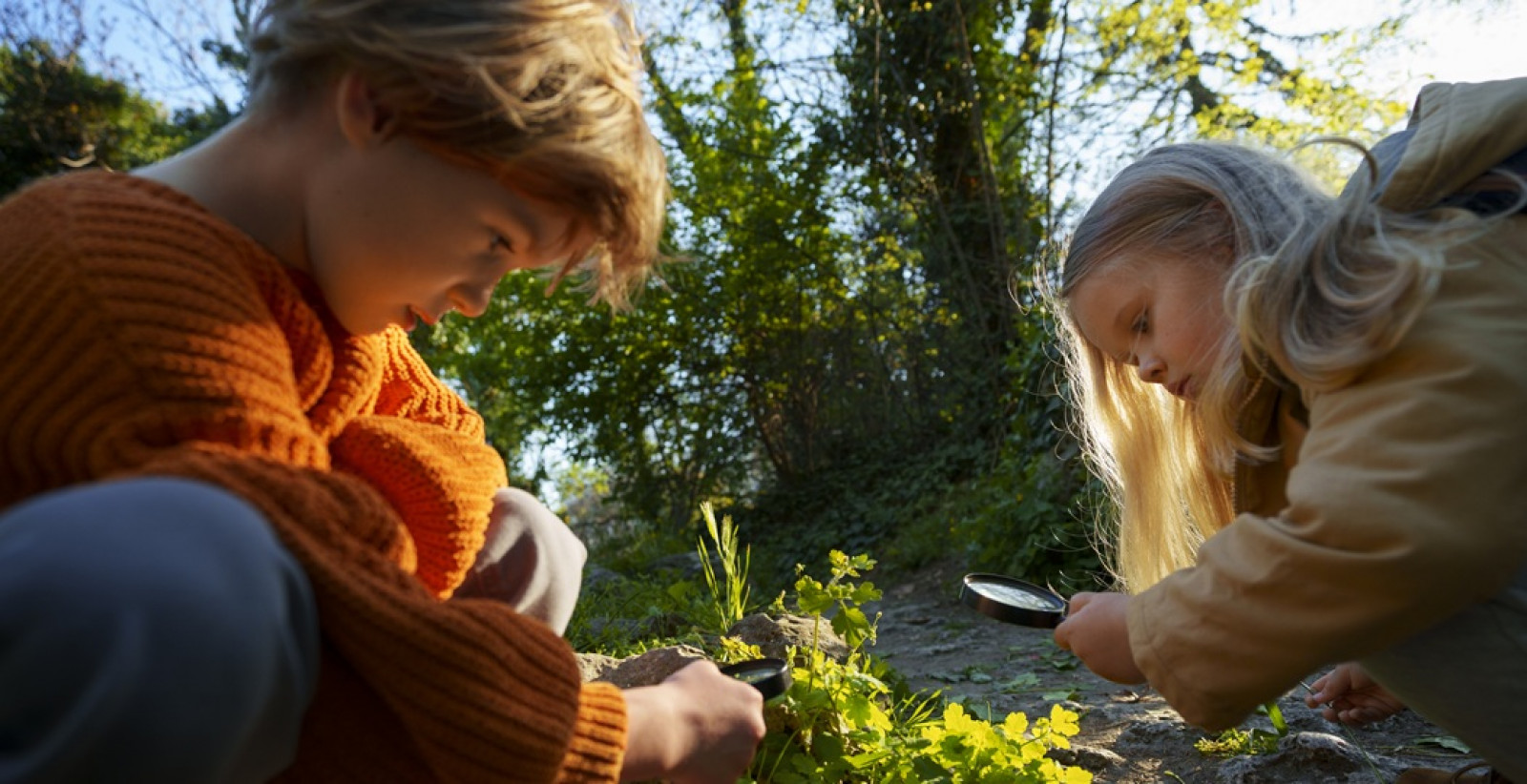
Ask a child to draw a scientist and you tend to get the same picture: a white coat, a bench, a beaker, indoors. It is a narrow image of STEM, and it quietly teaches children that real science happens somewhere they are not. Yet the most under-used laboratory most schools already own has no roof. It is the schoolyard — and for science, technology, engineering and mathematics alike, it may be one of the most authentic classrooms a school has.
The problem isn't the bench — it's sitting still
The case against confining STEM to the lab bench does not rest on atmosphere; it rests on outcomes. In a meta-analysis of 225 studies of undergraduate STEM courses, Freeman and colleagues compared traditional lecturing with active learning — students doing something rather than only listening.¹ The result was decisive: performance on examinations rose by nearly half a standard deviation under active learning, and students in traditional lectures were about one and a half times more likely to fail the course outright.¹
The study was conducted in universities, and the schoolyard is not a lecture hall. But the mechanism it identifies is general and it travels downward: learning that asks students to observe, measure, test and build outperforms learning that asks them to sit and receive. A lab bench can host either. The trouble is that so much STEM teaching drifts toward the passive end — the diagram, the pre-filled table, the demonstration watched from a stool. An outdoor lesson is, almost by its nature, the active kind.
The most under-used laboratory most schools already own has no roof.
The evidence for the outdoor laboratory
Move the lens from lecture halls to school grounds and the picture holds. Synthesising two decades of research on garden-based learning across forty-eight studies, Williams and Dixon found a preponderance of positive effects on academic outcomes — with the single largest gains in science, followed by mathematics.² In other words, where a green space is used for teaching, the subjects that benefit most are the S and the M of STEM. The authors are careful, and so should we be: the underlying studies were often methodologically thin, so the direction of the evidence is clearer than its precise size.² But the direction is consistent.
Two further findings reinforce it. Lessons taught in a natural setting have been shown to improve pupils' engagement in the very next indoor lesson — not to leave them too restless to work, but to sharpen their focus for what follows.³ And a systematic review of regular, timetabled outdoor classes points to broad benefits across learning, social development and health.⁴ None of this says the indoor lab is worthless. It says the outdoor one has been badly underrated.
What STEM actually looks like outside
The abstract case becomes concrete the moment you walk the grounds with each letter of the acronym in mind.
Science is the most obvious fit. A single tree is a year-long experiment: record the date its buds break, the week it flowers, the day its leaves turn, and a class has built a real phenology dataset with its own hands. A planting bed is a study in pollination, life cycles and soil; a pond is an ecosystem; a wall of ivy is a habitat survey waiting to happen.
Technology lives here too, and not as a gimmick. Mapping the grounds, logging observations, contributing to a citizen-science platform, or scanning a plant's digital label to pull up and check a record are all genuine data skills — the same collect-store-analyse loop that underpins modern science, practised on data a student helped create.
Engineering is the letter schools most often forget they can teach outside, yet the schoolyard is full of it. A rain garden or a wadi that manages stormwater is a designed system built against real constraints; so is a raised bed, a compost system, or a simple weather station. Designing, building and then watching whether it works is the engineering cycle in miniature.
Mathematics is everywhere a tape measure reaches. Pupils can measure trunk girth and estimate a tree's height, calculate its growth rate between terms, treat the canopy as a problem in area and ratio, sample and average across a bed, and graph the phenology data science gave them. The numbers are real, which is exactly why they stick.
Why real systems teach better than tidy ones
There is a reason a dataset a student gathered outdoors lands differently from one printed in a textbook. The plant is a real variable: it varies, it surprises, it refuses to behave — and wrestling with that messiness is closer to how science actually works than any pre-solved worksheet. Contact with the real thing is also what builds lasting interest in it. When plant scientists are asked what first drew them to their field, the recurring answer is early, hands-on experience, not facts learned from a page.⁵ A child who has measured a tree, watched it change and recorded the change is forming both a skill and an attachment that a diagram cannot supply.
The takeaway
STEM was never meant to be a set of facts delivered at a bench. It is a way of finding things out — observing, measuring, modelling, building, and revising when the world disagrees. Those are exactly the things a schoolyard invites, on real systems, with data students gather themselves. The evidence says active, hands-on learning outperforms the passive kind,¹ and that when green space is used for teaching, science and maths gain the most.² The lab bench has its place. But a school that keeps all of its STEM indoors is leaving its most authentic laboratory standing empty outside the window.
Sources
- 1. Freeman S, Eddy SL, McDonough M, Smith MK, Okoroafor N, Jordt H, et al. Active learning increases student performance in science, engineering, and mathematics. Proceedings of the National Academy of Sciences. 2014;111(23):8410–8415. Available from: https://www.pnas.org/doi/10.1073/pnas.1319030111
- 2. Williams DR, Dixon PS. Impact of garden-based learning on academic outcomes in schools: synthesis of research between 1990 and 2010. Review of Educational Research. 2013;83(2):211–235. Available from: https://journals.sagepub.com/doi/abs/10.3102/0034654313475824
- 3. Kuo M, Browning MHEM, Penner ML. Do lessons in nature boost subsequent classroom engagement? Refueling students in flight. Frontiers in Psychology. 2018;8:2253. Available from: https://www.frontiersin.org/articles/10.3389/fpsyg.2017.02253/full
- 4. Becker C, Lauterbach G, Spengler S, Dettweiler U, Mess F. Effects of regular classes in outdoor education settings: a systematic review on students' learning, social and health dimensions. International Journal of Environmental Research and Public Health. 2017;14(5):485. Available from: https://www.mdpi.com/1660-4601/14/5/485
- 5. Jose SB, Wu C-H, Kamoun S. Overcoming plant blindness in science, education, and society. Plants, People, Planet. 2019;1(3):169–172. Available from: https://nph.onlinelibrary.wiley.com/doi/full/10.1002/ppp3.51