
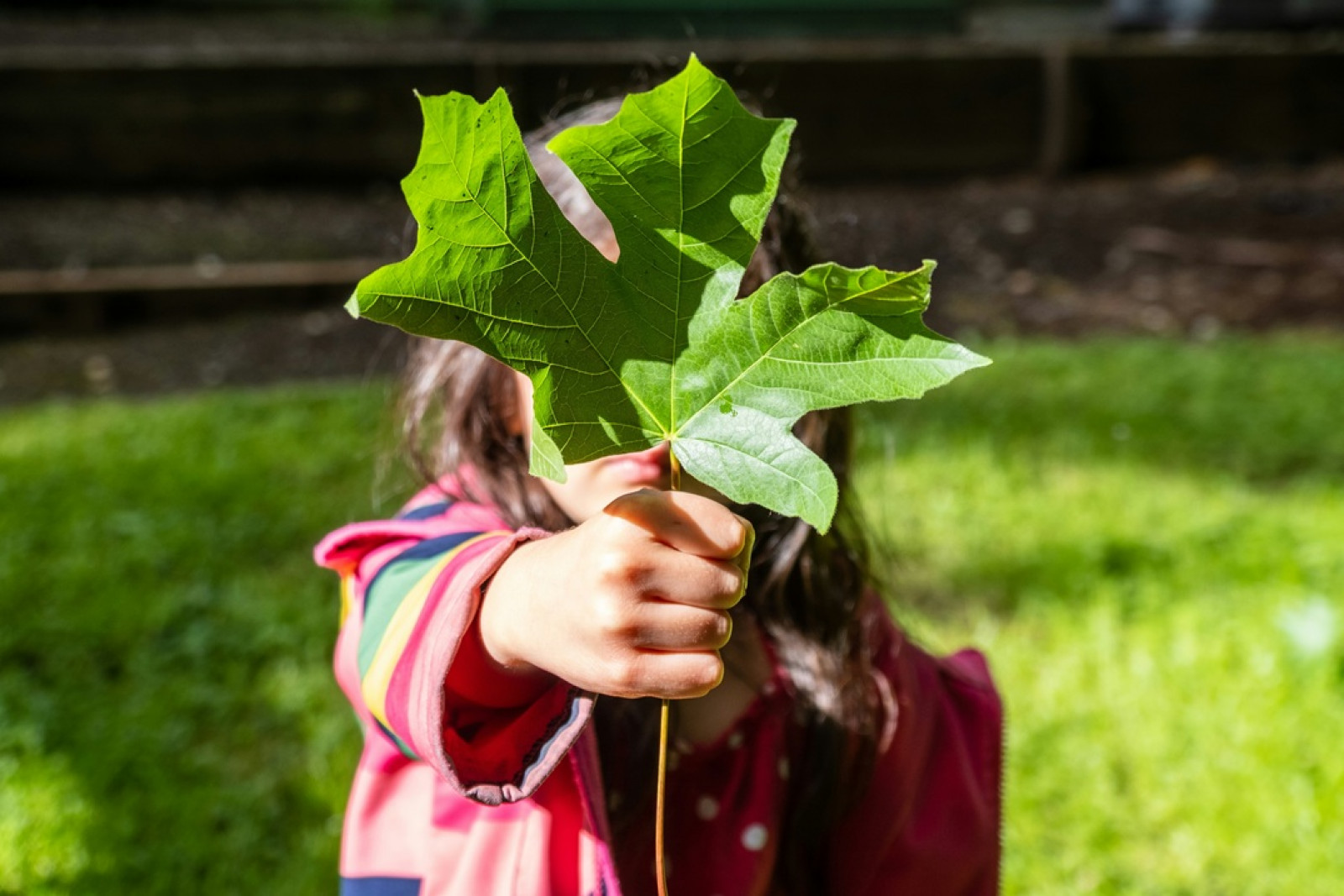
There is a study, frequently cited and frequently misquoted, that compared what children recognise. It found that British children aged eight could identify, on average, far more brand logos than plant species in their local environment. The exact numbers vary across versions of the study, but the direction is uncontested: children see brands. They do not see plants.
This is not a moral failing of children. It is the inevitable result of an environment that surrounds them with logos from infancy and shows them plants only as background. Brands compete for attention with movement, colour, and reward. Plants offer none of those signals at the speed children's developing visual systems are tuned to. The contest is unfair from the start.
But here is what makes this a school problem, not just a parenting problem. There is a window in which children remain naturally open to plants — roughly between ages three and eight, with diminishing returns thereafter. Teachers who use that window can produce lasting plant awareness. Teachers who miss it are working uphill for the rest of the child's school years.
A child who stops noticing plants at twelve becomes an adult who walks through a botanical garden and sees green wallpaper.
What works in early plant education
Twenty-five years of research, neatly summarised in Stagg and Dillon's 2022 review and Kuo and colleagues' 2019 work on outdoor learning, points to four things that consistently produce plant awareness in young children.
Direct contact beats representation. A child who plants a seed, watches it grow, and tastes its leaf forms a relationship that no textbook diagram replicates. This is not nostalgic preference — it is reflected in measured outcomes on plant identification, recall, and stated interest a year later.
Ownership creates investment. A child who is responsible for a particular plant — watering, pruning, observing — never forgets that species. This single intervention often outperforms much more elaborate curriculum work.
Stories lodge in memory. A child who learns that a particular tree was planted by their school's first headmaster forty years ago has an emotional anchor that pure biology cannot match. This is the same finding that runs through the broader plant-awareness research, and it applies even more strongly to children.
Outdoor time matters even when the lesson is not specifically about plants. Children taught in outdoor settings consistently show better attention, better recall, and better engagement than those taught the same content indoors. The schoolyard is, in this sense, an underused teaching tool.
Where technology actually helps
There is, fairly, scepticism about adding more screens to children's education. Much of it is well-founded. Children spend too much time on devices already. Adding more digital content to school life, without thought, makes the problem worse.
But there is a specific use case where technology earns its place: bringing children outside and giving them depth once they are there. A QR code on a tree in a schoolyard does something different from a screen indoors. It is an invitation outside. The visit happens in the real world. The screen is a brief, optional supplement that adds context — the history of the tree, a time-lapse of its seasonal change, an audio recording of birds that nest in it.
Used this way, technology is not competing with outdoor learning. It is enabling it. A teacher with thirty children and one schoolyard cannot personally tell each of them the story of every plant. A QR code can.
A worked example: the Sint-Pietersinstituut model
The Sint-Pietersinstituut in Belgium became, in recent years, the first secondary school in Europe to receive ArbNet accreditation. The path they took offers a useful template for any school considering similar work.
The school did not start with technology. They started with planting. They identified species in their existing schoolyard. They made the schoolyard into a teaching tool, with plants chosen and labelled for educational use. Only then, with the planting and the curriculum integration in place, did digital labels enter the picture — to extend what teachers were already doing, not to replace it.
The result, after several years, is a schoolyard that doubles as an outdoor classroom, with biology, language, history, and even philosophy lessons connected to specific plants. Pupils know specific tree species, can describe their seasonal changes, and recognise the same species when they encounter them elsewhere. The plant blindness that the broader research describes is, in this microcosm, measurably reduced.
It is worth noting that this is one school's experience, not a controlled trial. But the pattern matches the wider literature: hands-on contact, sustained relationships with specific plants, and curricular integration produce plant awareness. Add discreet, well-designed digital depth, and the effect deepens.
Practical guidance for school leaders
For headteachers, biology coordinators, or governance boards considering this kind of work, a few principles tend to make the difference between a project that lasts and one that fades after a year.
Start small. Ten plants identified, learned, and storied across one school year is more useful than fifty plants installed and forgotten. The aim is sustained relationship, not a one-time installation.
Integrate into the curriculum. A schoolyard project that lives outside biology lessons depends on individual enthusiasm and dies when teachers change. A schoolyard project woven into multiple subjects survives.
Involve the pupils in content creation. Children who write the story of "their" plant develop attachment to it that no externally written story can produce. This also distributes the editorial work, which is otherwise a real burden on already-stretched teachers.
Measure outcomes. A simple pre- and post-year plant identification quiz tells you whether the work is moving the needle. Without measurement, every claim about educational impact is intuition. With measurement, the case for continued investment becomes evidence-based.
A generation that sees plants
The argument for plant-aware education is not nostalgic and not anti-technological. It is an argument about what literacy means in the next century.
A generation that cannot name the trees that produce their oxygen, recognise the plants that feed them, or notice the species disappearing around them is a generation poorly equipped for the climate decisions ahead. Plant literacy is not a hobby for botanists. It is foundational to ecological citizenship.
Schools are the place where that literacy starts or fails to start. The window in which children remain open to plants is real, and narrower than most teachers realise. The schoolyard is the most underused teaching tool most schools have. And the technology to extend the schoolyard into a layered, story-rich learning environment is now mature, cheap, and accessible.
The next generation can see plants. Whether they do depends, more than anyone in education currently admits, on what schools do with the next five years.
Bronnen
- (1999). Preventing plant blindness . The American Biology Teacher
- (2022). Plant awareness is linked to plant relevance . Plants, People, Planet
- (2019). Do experiences with nature promote learning? Converging evidence of a cause-and-effect relationship . Frontiers in Psychology
- (2009). Children and nature-deficit disorder . Journal for Specialists in Pediatric Nursing